– GlobalChipSupply
The Tesla Cybertruck represents a revolutionary advancement in electric vehicle technology, introducing groundbreaking innovations in high-voltage power management and charging infrastructure. This comprehensive analysis examines the vehicle’s high-voltage components and the breakthrough PCS2 (Power Conversion System 2) that employs single-stage topology architecture. The Cybertruck’s transition to an 800V electrical platform, combined with 48V low-voltage architecture and bidirectional charging capabilities, establishes new industry benchmarks for electric vehicle power systems.
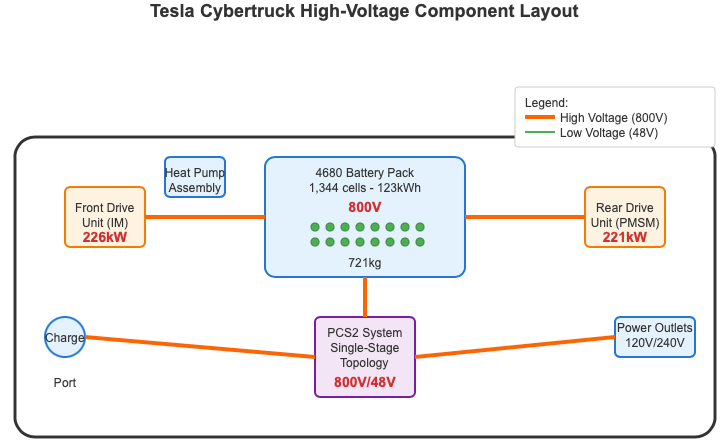
The Tesla Cybertruck’s high-voltage system represents the core of its electrification architecture, managing energy storage, distribution, and power delivery through an integrated network of batteries, motors, controllers, and power conversion systems. The vehicle implements Tesla’s first production 800V high-voltage platform alongside innovative 48V low-voltage architecture.
The Cybertruck utilizes an 800V architecture with sophisticated drive unit configurations that vary across three distinct models:
Single Motor Configuration: Rear-wheel drive with a single Permanent Magnet Synchronous Motor (PMSM) on the rear axle.
Dual Motor Configuration: All-wheel drive featuring an Induction Motor (IM) on the front axle producing 226kW maximum power, paired with a PMSM on the rear axle delivering 221kW.
Tri-Motor Configuration: Advanced all-wheel drive with a front PMSM producing 206kW and dual rear Induction Motors for maximum performance capability.
The modular approach allows Tesla to optimize performance, efficiency, and cost across different market segments while maintaining manufacturing scalability.
The integrated heat pump system provides comprehensive thermal management for both cabin comfort and powertrain efficiency. The system controls refrigerant circulation through expansion valve modulation and check valve operation, while managing coolant flow through an eight-way valve configuration for optimal temperature regulation across all vehicle systems.
All orange-coded wiring harnesses indicate high-voltage connections throughout the vehicle, ensuring proper identification and safety protocols during service operations. The harness system interconnects all high-voltage components with appropriate shielding and insulation for the 800V operating environment.
The Cybertruck employs Tesla’s advanced 4680 cylindrical lithium-ion battery cells with Nickel Cobalt Manganese (NCM) chemistry. The battery pack specifications include:
The battery system incorporates Tesla’s structural pack design, serving as a load-bearing component of the vehicle chassis while providing exceptional energy density and thermal management capabilities.
Strategically positioned service access panels enable authorized technicians to safely perform maintenance and component replacement on high-voltage systems. These covers incorporate appropriate safety interlocks and warning systems to prevent inadvertent exposure to high-voltage circuits.
The rear axle motor configuration varies by model variant, with the standard setup featuring a 221kW PMSM for rear-wheel propulsion. In tri-motor configurations, the rear axle accommodates two Induction Motors paired with the front PMSM for maximum performance output.
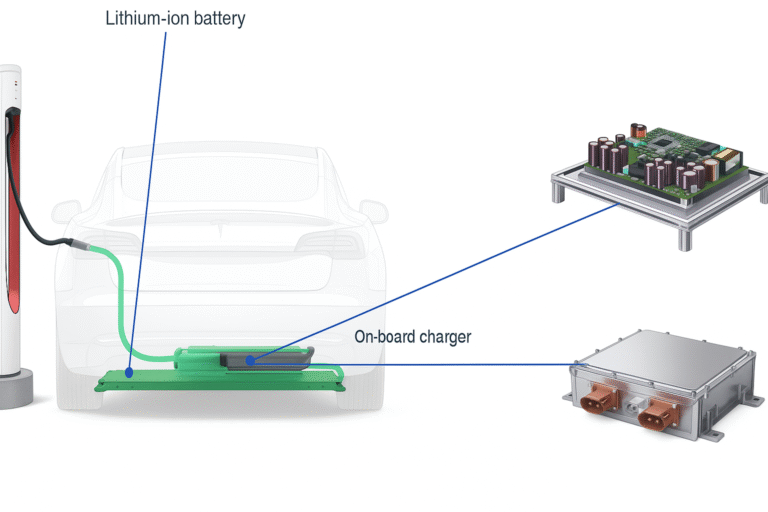
The Cybertruck supports both Tesla Supercharger compatibility and third-party charging infrastructure, interfacing through the revolutionary PCS2 power conversion system. The charging port accommodates both AC and DC charging protocols with intelligent power management.
The vehicle includes multiple 120V and 240V outlets in both the truck bed and cabin, providing up to 9.6kW continuous power output for tools, equipment, and appliances. The 240V outlet supports up to 40A current draw, while 120V outlets provide 20A maximum current.
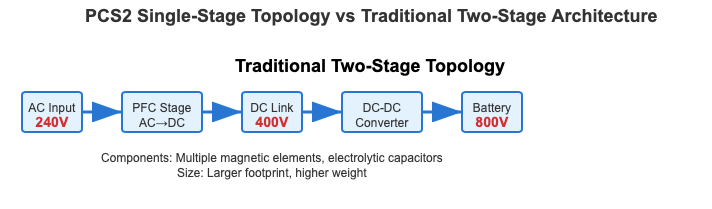
The PCS2 represents Tesla’s most significant advancement in automotive power electronics, introducing revolutionary single-stage topology architecture that fundamentally reimagines electric vehicle charging and power management systems.
Compared to Tesla’s previous generation charging systems, the PCS2 achieves remarkable size and weight reduction through advanced integration techniques:
Size Reduction: Approximately 50% volume reduction compared to previous Tesla charging systems Weight Optimization: Significant mass reduction through advanced materials and topology optimization Power Density: Industry-leading power-to-volume ratio through innovative magnetic component integration
The compact design stems from multiple technological breakthroughs, particularly the single-stage topology architecture that eliminates traditional power conversion stages and reduces magnetic component count.
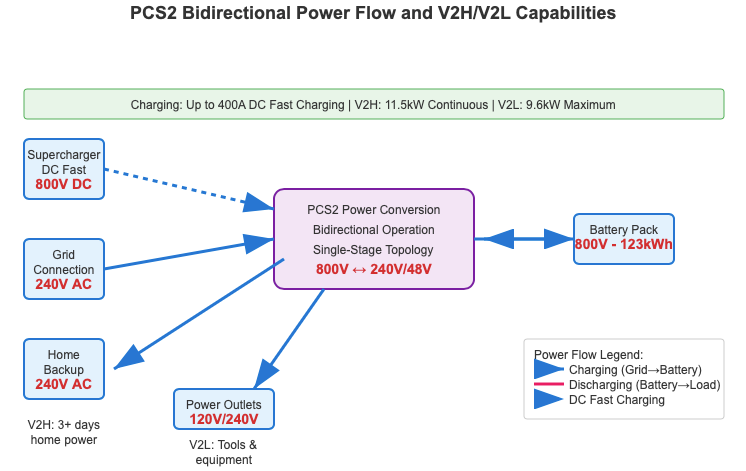
The PCS2 operates as an 800V/48V OBC + DC/DC combination unit, enabling sophisticated bidirectional power flow management:
Vehicle-to-Home (V2H): Up to 11.5kW continuous power output capability for residential backup power applicationsVehicle-to-Load (V2L): Direct power export through integrated outlets for tools and equipment DC Fast Charging: Support for up to 400A charging current through DC fast charging protocols Grid Integration: Seamless integration with Tesla Powerwall systems for comprehensive energy management
The bidirectional capability transforms the Cybertruck into a mobile energy storage system, providing over three days of typical residential power consumption (assuming 30kWh daily usage).
The transition from Tesla’s traditional 12-16V low-voltage architecture to 48V represents a fundamental shift in automotive electrical design:
Dual AC-DC Converter Architecture: Redundant power conversion units provide fail-safe operation for safety-critical systems Steer-by-Wire Compatibility: Reliable power supply for electronic steering systems with seamless failover capability Modular Design: Scalable PCB architecture enabling component reuse across multiple vehicle platforms Enhanced Efficiency: Reduced current requirements and improved power distribution efficiency
The dual converter design ensures continuous operation even if one unit fails, critical for safety systems including steer-by-wire functionality.
Traditional automotive charging systems employ two-stage power conversion architectures with separate Power Factor Correction (PFC) and DC-DC conversion stages. The PCS2’s single-stage topology eliminates the intermediate conversion stage, providing:
Simplified Architecture: Reduced component count and improved reliability Cost Optimization: Lower manufacturing costs through component reduction Enhanced Efficiency: Minimized conversion losses through direct power transformation Compact Design: Smaller footprint and reduced weight compared to multi-stage systems
The single-stage approach represents a paradigm shift in automotive power electronics, setting new standards for integration and efficiency.
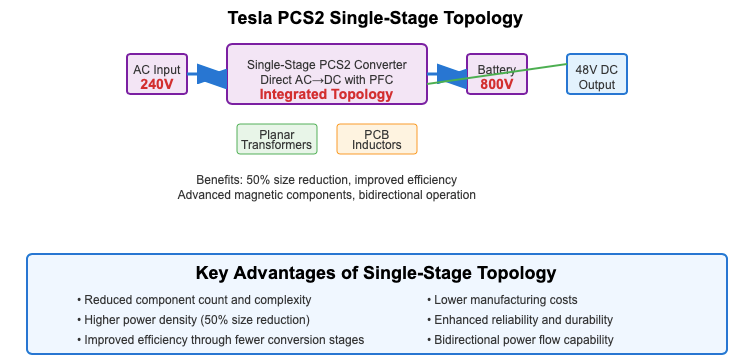
The PCS2 incorporates groundbreaking magnetic component technologies:
Planar Transformers: Advanced PCB-based planar transformer construction replaces traditional copper wire windings, utilizing ferrite cores with integrated PCB copper layers for compact, high-frequency operation.
Integrated PCB Inductors: Elimination of bulky electrolytic capacitors through direct PCB integration of inductive components, featuring copper spiral traces paired with solid ferrite cores.
Nanocrystalline EMI Filters: Advanced magnetic materials minimize power core size while maximizing performance and electromagnetic compatibility.
These innovations collectively reduce size, improve reliability, and enhance manufacturability compared to conventional wound magnetic components.
Unlike conventional multi-PCB automotive charging systems, the PCS2 employs innovative single-board architecture:
Unified PCB Design: Single printed circuit board integrating all power and control functions Quad-Core ARM Cortex-R5F MCU: Advanced microcontroller managing both high and low voltage operations Reduced Complexity: Simplified assembly and manufacturing processes Space Optimization: Minimized interconnections and improved packaging efficiency
This approach contrasts with typical industry practice using multiple PCBs for different functions and represents Tesla’s commitment to integration and cost optimization.
The PCS2 thermal management system builds upon Tesla’s proven cooling technologies while incorporating refinements for enhanced durability:
Cold Plate Technology: Liquid cooling interface for efficient heat extraction Perimeter Sealing: Enhanced environmental protection and thermal isolation Thermal Gap Materials: Advanced interface materials optimizing heat transfer Mechanical Reinforcement: RTV reinforcement addressing vibration and long-term reliability concerns
The thermal design reflects Tesla’s accumulated experience in automotive power electronics, optimizing for both performance and long-term reliability.
The Cybertruck’s PCS2 system establishes Tesla’s continued leadership in automotive electrification technology. The single-stage topology approach, combined with 800V architecture and bidirectional charging capabilities, creates a template for next-generation electric vehicle power systems.
The PCS2’s innovations extend beyond Tesla’s ecosystem, potentially influencing industry-wide adoption of:
Ongoing development areas for Tesla’s power electronics include:
Semiconductor Integration: Continued advancement in Silicon Carbide (SiC) MOSFET technology for higher efficiency and power density
Magnetic Materials: Further optimization of nanocrystalline and advanced ferrite materials for enhanced performance
System Integration: Deeper integration between charging systems, battery management, and vehicle control systems
Grid Integration: Enhanced vehicle-to-grid (V2G) capabilities supporting renewable energy integration and grid stability
The Tesla Cybertruck’s high-voltage architecture and PCS2 power conversion system represent significant technological advances in electric vehicle electrification. The single-stage topology innovation, combined with 800V/48V architecture and comprehensive bidirectional charging capabilities, establishes new benchmarks for automotive power electronics.
These innovations demonstrate Tesla’s commitment to pushing technological boundaries while addressing practical challenges in electric vehicle adoption, including charging efficiency, energy management, and system integration. The PCS2’s revolutionary approach to power conversion topology positions Tesla at the forefront of automotive electrification technology, setting the foundation for future electric vehicle development across the industry.
The combination of advanced materials, sophisticated control systems, and innovative circuit topologies in the PCS2 creates a comprehensive solution that addresses current limitations while anticipating future requirements in electric vehicle power management. This technical leadership reinforces Tesla’s position as a driving force in the global transition to sustainable transportation.
This analysis is based on publicly available technical information and industry analysis. For detailed technical specifications and implementation guidelines, consulting official Tesla documentation and certified technical resources is recommended.

